
Are you discovering how Military-Grade Mental Health principles can help you stay calm, sharp, and unbreakable under fire?”
In This Blog
What Does “Military‑Grade Mental Health” Really Mean?
In the age of modernization, mental resilience is essential for every individual. “Military-Grade Mental Health” is a concept that means soldiers, whose lives are very tough, adopt certain strategies to stay healthy. The term “military grade” is not used only for weapons or armor, but it highlights mental strength, emotional endurance, or psychological readiness. This term makes individuals sharp and focused in situations of anxiety, stress, or trauma, rather than being pressured. But to adopt this concept, you don’t need to wear a uniform and fight battles. Many parents, youngsters, or students should apply the principles of military grade mental health for emotional control.

In this section, we’ll discover the term “Military-Grade Mental Health and explore how its strategies can be adapted for everyday life.
Why Traditional Mental Wellness Might Not Be Enough
Everyday Tips vs Real-Life Pressure
Traditional Wellness advice also helps to avoid stress such as running late or feeling overwhelmed, etc. People face troubles, hardships, or extreme situations in the military. In real life, responders, healthcare workers, leaders, parents, or students face constant pressure and need these self-care tips.
Why Modern Life Feels Like a Battlefield
In the 21st century, life is like a war zone. For the battlefield, we don’t have to wear any uniform. Constant alerts, financial problems, long work hours, or social media noise put your mind in survival mode. This kind of stress can exhaust you and also affect your focus, mood, or energy. But in Military-Grade Mental Health, you’re given guidelines to stay positive, or you need real
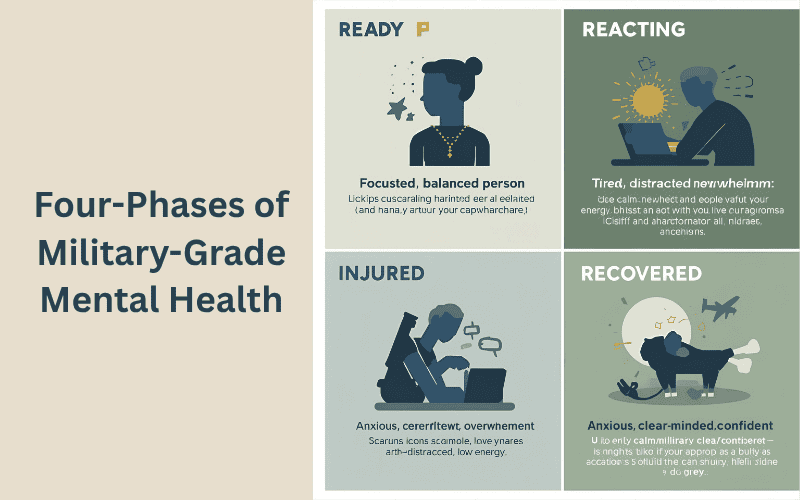
The Four-Phases of Military-Grade Mental Health
Ready phase: The first phase is the “Ready phase”.In this phase, you handle your responsibilities with focus and can bear the stress load. This is the stage that all individuals want to be in.
Reacting phase: The second phase is the “Reacting phase”. When your stress builds up, you move from “Ready phase” to “Reacting phase”. In this phase, you recognise early signs of mentalyou are very tired or not able to sleep well. But then, you perform work but do not perform at your best. This is the stage that people ignore. At this stage, you need to take small actions like sharing your problems with someone, adjusting your routine better, or getting better rest, etc.
Injured phase: The third phase is the “Injured Phase.” During this stage, your stress limits are crossed, or you feel numbness in your daily life activities. You often feel anxious, tense, or disconnected.
This situation means your mind wants to say,
“I need help.”
Whether you are in the military or not, you should visit a therapist, support group, or mental health service provider during this phase. You should not make yourself vulnerable, but you should be smart and prevent the situation from getting worse.
Recovered phase: The fourth phase is the ” Recovered phase”.But the individual doesn’t simply return to the traps of normal life but rather finds new strengths. You have to stay mentally, emotionally, or physically strong to build better systems. Military-grade resilience helps you recognize your falling points, or to become stronger.
Build Your Mental Armor: Foundational Practices
Physical Readiness for the Brain: Sleep, Nutrition, Movement
If you are not physically fit, your mind cannot function properly. That’s why Military-Grade Mental Health starts with the basics:
- Sleep repairs or resets your mind. Lack of sleep also affects your mood, memory, and decision-making power.
- Nutrition provides fuel to the mind. Highly processed foods or low nutrients can also make you feel anxious or worried.
- Movement is also helpful in balancing your stress hormones. Walking or light workouts can keep your mind clear, and you may not need to run marathons.
These aren’t just health tips, but they’re protective habits that give strength to your mental health. Soldiers are trained to prioritize all these habits.
Psychological Readiness: Mission Mindset, Clarity, Purpose
Military-Grade Mental Health provides you with willpower and a clear reason to keep going. In the military, every task has a mission. This is the same idea to adopt in real life. By implementing it, we can strengthen our mental strength.
Ask yourself:
- What am I really working toward?
- What things matter most right now?
- How do I stay when things get tough?
When you implement the “mission mindset” in your life, you can easily manage stress by making a proper plan.
Recognizing Early Warning Signs Before They Escalate
Subtle Changes That Signal “Reacting” Mode
Many people do not suddenly become victims of mental health problems, but they move towards such mental health problems gradually.
- When you’re more irritable or snappy
- When you feel sleepy or your appetite changes
- When you feel “off,” unmotivated, or foggy
- When you start withdrawing from people or skipping routines
In Military-Grade Mental Health, military men are provided with trained skills to understand these signs, and these are powerful in civilian life.
Quick-Action Tools to Stop Stress from Getting Worse
When you enter in reacting phase, you should not ignore it and react rather quickly or gently. You should have some practical things.
Take a tactical pause: Step back, breathe, and reset. Even five minutes can help.
Talk to someone you trust: Speaking out early makes a huge difference.
Check your basics: Are you getting enough sleep? Are you eating real food? Do you move your body?
These are some techniques to survive real stress. Military teams apply these strategies to remain sharp or stable in high-pressure environments.
When the Stress Hits Hard: Responding Like a Trained Operative
The “Injured” Phase: What Happens Under Sustained Pressure
When the stress limit is exceeded, your brain and body do not perform well.
- You might feel emotional numbness or explosive
- Feel constantly anxious, traumatized, or on edge
- Exhausted but unable to sleep
- Hopeless, like nothing will improve
- Dependent on unhealthy habits like alcohol, avoidance, and self-isolation
These are not your bad habits, but soldiers also experience them. It guides you on what to do next.
Intervention Tactics Drawn from Military Mental Health Models
In the army, when someone enters the injured phase, they are not alone but are provided targeted support. In the same way, support in daily life can be helpful for the mental health of the patient.
Here are some battle-tested intervention strategies that we can use.
Speak to a professional early: As soon as the injury phase begins, contact a professional. A professional will guide you through therapy or counseling. Therapy is a tool for recovery.
Create a crisis response plan: Identify 2–3 trusted people and let them know you might reach out. Keep support hotlines or mental health contacts handy.
Use structured routines: Even small routines like wake-up time, meals, and walks help stabilize your brain.
Take time off if needed: Just as individuals require rest for healing from physical injuries, similarly, individuals with mental injuries also require rest for recovery.
Also Read About!
Wonderful Mental Health Check-In Worksheet: A Wellness Guide Here!
Long-Term Mental Health Strategy: Avoiding the “Ill” Phase
Why Ignoring Warning Signs Leads to Burnout or Worse
Many people ignore warning signs because it’s too late. Long-term stress without support creates a variety of problems.
- Burnout affects our work, relationships, and health
- Substance misuse as a way to cope
- Your serious mental health condition may be difficult to manage, such as anxiety disorders or suicidal thoughts.
- Military-grade mental health focuses on early treatment. The sooner you consult a doctor, the greater your chances of recovery and the less stress you will suffer.
Building Ongoing Recovery Routines That Last
Mental Health fitness is a process that helps you maintain your physical fitness. Adopt long-term habits to relax your mind.
Regular check-ins: Analyze yourself weekly to see how you are doing and what you need.
Scheduled downtime: Maintain a Proper Rest schedule and adopt healthy hobbies. This is essential for a healthy life and a healthy mind.
Community support: Share your problems or worries with those who will listen to you attentively instead of judging you.
Professional maintenance: You don’t need a crisis to benefit from therapy, coaching, or mental health check-ups.
Changing the Culture: From Stigma to Strength
How Military Culture Handles Mental Health Differently
In the Military, the well-being of the soldiers is taken care of. Hiding struggles puts the entire team at risk, so they protect and support everyone to treat mental health. In the Army, mental health is valued rather than considered a shame.
Translating That Into Your World: Transparency, Support, Readiness
To adopt military culture, you don’t need to wear a uniform; you can create a space in your home, office, or community.
- It’s safe to confront mental health issues without judgment.
- Everyone supports each other and appears as a unit.
- Asking for help is seen as a strength, not a weakness

Practical Tools to Apply Right Now
Daily Micro-Routines Worthy of a Soldier’s Mindset
Soldiers’ small, consistent habits build a strong mental army. Try adopting these habits in your own life.
Morning mental check-in: Analyze your stress rate for 2 minutes daily in the morning.
Movement break: After every hour, stand up, stretch, or walk for 5 minutes.
Gratitude pause: Before sleeping, jot down one thing you’re thankful for.
Clear mission: Write down your top 1–3 priorities for the day and stick to them
These small habits keep you focused and prepared to lead a better lifestyle.
Team and Social Support: Creating Your Own “Unit”
Koi b soldier battle akely nahi LR skta islyay wo team bna kr battle myn jaty hyn. Islyay AP b apni compatibility k logon k sath aik team bnayn or unit create kryn.
A soldier cannot fight a battle alone; that’s why they make a team and fight united in battle. So, you should also make a team with those who have compatibility with you and create a unit.
- Those who listen to you without judgment
- Who encourages you to take care of yourself?
- Offer honest feedback and support when needed
Your close friends, colleagues, family members, or support groups are included in this unit. It works by typing a key for the Connection family. The moral of the story, “Union is strength,” applies here.
Conclusion: Building Mental Strength That Lasts
In today’s fast-paced or high-pressure world, mental health is a continuous journey.Military-Grade Mental Health mindset provides different strategies to reduce your stress. Better physical or psychological readiness, identifying early warning signs, and creating supportive units in your own circle, create strength for our mental health. Mental toughness does not mean ignoring your struggles but taking practical steps to remain consistent and protect your mind.
Start today. Build your mental armor. and face life with the confidence of someone trained to thrive — no matter what comes your way.
Frequently Asked Questions
How does the military affect mental health?
Military service can expose individuals to high stress, trauma, and separation from family, impacting emotional well-being. However, it also builds resilience, discipline, and coping skills through structured support systems.
What are the 5 C’s of mental health?
The 5 C’s of mental health—Competence, Confidence, Connection, Character, and Contribution—promote overall psychological resilience. These pillars help individuals build strong emotional balance and a positive mindset.
How does the military evaluate mental health?
The military uses psychological screenings, behavioral interviews, and ongoing assessments to evaluate mental fitness. These evaluations identify stress levels, trauma signs, and readiness for duty or deployment.
What is SMI in mental health?
SMI (Serious Mental Illness) refers to conditions like schizophrenia, bipolar disorder, or major depression that severely affect daily functioning. Early diagnosis and continuous treatment are crucial for recovery and stability.

Sameya Salman is a writer at The Fit & Fresh who researches and writes about mental health and emotional well-being, with a focus on making topics like high-functioning depression easy to understand. She researches each article using trusted mental health sources to help readers recognize symptoms, understand treatment options, and feel less alone.

