Are you wondering how Mental Health CPT Codes can transform your practice’s revenue and protect you from mistakes in billing? Let’s know!
In This Blog
What Are Mental Health CPT Codes and Why Do They Matter?
Mental Health CPT Codes can be beneficial for therapists, counselors, or psychiatrists in accurately billing. These CPT codes are also known as universal codes. These codes describe the evaluation of the sessions or treatment you provide. Using the right codes can help you get paid on time or avoid insurance denials. Using the wrong codes can result in lost revenue or rejected claims.
In this section, you’ll discover these codes, how they apply to mental health, and why understanding them is essential for running a successful practice.
Understanding CPT Codes in Mental Health Billing
The word CPT stands for Current Procedural Terminology. CPT codes are used to bill insurance for psychiatric sessions, therapy sessions, or psychological testing.
For example:
90834 = Used for 45-minute therapy session
90791 =For initial psychiatric evaluation
90847 =For service of family therapy with the patient present
Each service has a specific code and duration. Therefore, using the right code is best for clear communication and proper compensation.
Why Accurate Coding Affects Reimbursement and Compliance
Incorrect or incomplete coding becomes a cause to:
- Claim denials
- Delayed payments
- Audit risks
On the other hand, accurate coding offers medical necessity, supports claims, and protects your practice legally and financially.
The Most Common Mental Health CPT Codes Explained
Psychotherapy Codes by Time: 90832, 90834, 90837
The charges or bills for some therapy sessions depend on their duration. The codes based on the duration of the therapy session are called psychotherapy CPT codes. The table below explains those three codes and their uses.
| CPT Code | Service Description | Typical Session Duration | When to Use |
| 90832 | Psychotherapy, but it is a short session. | 16–37 minutes | Short therapy sessions or shorter checkups |
| 90834 | Psychotherapy, but it is a standard session | 38–52 minutes | Mostly used for typical therapy |
| 90837 | Psychotherapy and it is extended session | 53+ minutes | For longer checkups, in-depth therapy sessions |
Psychiatric Evaluation Codes: 90791 vs 90792
The codes that are used for the initial assessment, called Psychiatric Evaluation Codes. These are the codes 90791 or 90792, which are used for client’s first visit. The description or uses of the codes are explained in the table.
| CPT Code | Description | Who Typically Uses It | Includes Medical Services? |
| 90791 | Psychiatric diagnostic assessment | Therapists, psychologists | ❌ No |
| 90792 | Psychiatric diagnostic evaluation. Includes medical services | Psychiatrists, prescribing providers | ✅ Yes |
Family, Group, and Crisis Therapy Codes You Should Know
Billing for Couples and Family Sessions: 90846, 90847
For couples and family sessions, these codes 90846 and 90847 are used during therapy sessions. These codes are necessary whether the patient is present or not.
| CPT Code | Description | When to Use |
| 90846 | Used for Family or couples therapy sessions (without the patient) | For parent-only sessions or teamwork |
| 90847 | For Family or couples therapy (with the patient) | In the presence of the client in the session |

Group and Crisis Codes: 90853, 90839, 90840
These codes are used for group therapy and crisis intervention services.
| CPT Code | Service Type | Details |
| 90853 | Used for Group psychotherapy | Offers service for Non-family, therapeutic group led by a clinician |
| 90839 | Used in Psychotherapy for crisis | First 60 minutes of urgent psychological support |
| 90840 | For Crisis add-on | Provides additional 30 minutes beyond 90839 |
\ CPT Codes for Psychological and Neuropsychological Testing
Psychological Testing: 96130–96139 Overview
Evaluation, test selection, or interpretation is done through these codes by a psychologist or technician.
| CPT Code | Service | Who Performs It |
| 96130 | Offers Eval of tests (Used in first hour) | Psychologist or qualified provider |
| 96131 | Add-on for each additional hour | Same as above |
| 96136 | Test administration (first 30 mins) | Clinician or technician |
| 96137 | Additional 30 minutes (admin) | Clinician or technician |
| 96138 | Admin by technician (first 30 mins) | Technician only |
| 96139 | Technician-administered test | Technician only |
Brief Assessments and Screenings: 96127, 96110, 96112
These are used for short, standardized screenings in routine visits or checkups.
| CPT Code | Description | Example Tools |
| 96127 | Brief emotional/behavioral assessment | PHQ-9, GAD-7, Vanderbilt |
| 96110 | Offers Developmental screening | ASQ, M-CHAT |
| 96112 | Used in Developmental testing (first hour) | Bayley, Battelle |

Using Add-On and Complexity Codes Correctly
Interactive Complexity Code 90785: When and Why to Use It
90785 is a code used to provide therapy sessions to complex patients.
- Communication difficulties (e.g., faces language barriers)
- Patients with intellectual disability or severe emotional disturbance
- Offering care with multiple providers or outside agencies
This is a primary psychotherapy code used to manage the complexities of patients with severe conditions.
Psychotherapy Add-On Codes: 90833, 90836, 90838
These codes are used to bill therapy sessions when provided with psychotherapy evaluation and management.
90833:Used for a 30-minute psychotherapy session and also provides Evaluation and Management.
90836: Offers 45-minute psychotherapy with the service of Evaluation and Management.
90838: Provides 60-minute psychotherapy with Evopution and Management.
Also Read Here!
Children’s Mental Health Acceptance Day in Frankfort
Telehealth CPT Codes and Modifiers for Mental Health
Which Mental Health CPT Codes Are Approved for Telehealth?
90832, 90834, 90837 or 90792 psychotherapy or psychiatric evaluation Codes that are approved through telehealth. Always use these restrictions to approve individuals’ codes..Telehealth provides an important role in mental health care. It tells you main knowledge about your codes or correct use of modifiers.
Modifiers You Need: 95, GT, 93, and Place of Service Codes
Some proper modifiers are required to claim paid telehealth services.
95:It provides synchronous telemedicine service (real-time interactive audio and video)
GT: Offers interactive audio and video telecommunications system
93: 93 also offers Synchronous telemedicine service provided via telephone or audio-only (used temporarily during COVID)
How to Link CPT Codes with ICD-10 Diagnoses
Why Every CPT Code Must Be Tied to a Valid Mental Health Diagnosis
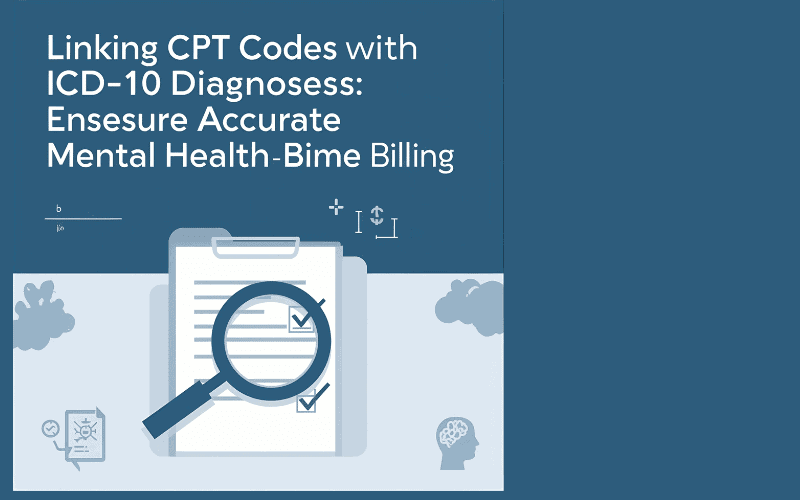
ICD-10 codes explain why a service is provided, or Mental Health CPT codes describe which services are offered. Insurance companies demand both codes to understand medical necessity. Claims are rejected without a valid diagnosis. Proper documentation of diseases plays a major role in providing better treatment. For example, an ICD-10 code for depressive disorder (F32.1) or an anxiety (F41.1) code keeps you compliant.
Common Diagnoses and CPT Pairings in Mental Health Billing
Some CPT codes pair with specific diagnoses to avoid confusion and improve claim approval. For example:
- 90834 is a 45-minute psychotherapy which often pairs with F32.1 (Major depressive disorder)
- 90832 is a 30-minute psychotherapy which commonly links with F41.1 (Generalized anxiety disorder)
- 90791 offers a Psychiatric evaluation and makes a pair with various diagnoses
- based on patient presentation.
Avoiding Billing Mistakes and CPT Code Denials
Billing mistakes can lead to lost income and delay issues.
Top Coding Errors That Mental Health Providers Make
The following are the most common errors:
- Using the wrong CPT code for an increased duration of sessions
- Forgetting necessary modifiers can also lead to a significant billing mistake.
- Wrong CPT codes with inappropriate diagnosis codes
- Billing for overlapping or undocumented time can also become restricted.
- Ignoring payer-specific rules for telehealth.
How to Prevent and Appeal Denied Claims
To avoid claims:
- Check twice the CPT and ICD-10 codes for accuracy
- Use appropriate and correct modifiers
- Keep detailed session documentation and knowledge
- Ensure and verify all payer policies before submitting claims
If a claim is denied:
- Review the cause of claim denial carefully
- Correct those errors which you face or provide additional documentation
- Resubmit properly.
- To clarify or dispute the denial, contact the insurer.
Updates to Mental Health CPT Codes for 2024–2025
Recent Code Changes and New Additions You Should Know
Telehealth expansions: Mental Health services have been approved for virtual delivery. Some additional code changes or information is added through Telehealth.
Testing updates: Recent codes help to clarify psychology or neuropsychological tests or differentiate roles of a clinician or technician.
Team-based care:Recent new codes provide integrated care and teamwork for complex patient care.
How These Updates Impact Therapists, Psychiatrists, and Counselors
These updates play an important role in documentation and submission of claims to therapists, psychiatrists
Mental Health CPT Coding Tips, Cheat Sheets, and Helpful Resources
Downloadable CPT Code Cheat Sheet for Mental Health Providers
Psychologists should provide a clear or printable cheat sheet of the most common mental health CPT codes after evaluation of sessions. This sheet can be used for quick reference in scheduling, billing, or team training.
Trusted Resources for Ongoing CPT Education and Compliance
Trusted and recommended resources are given below:
- The American Medical Association (AMA) provides official CPT updates
- American Psychological Association (APA) billing guides
- Industry webinars and coding workshops
Billing software tools with built-in CPT validation.
According to the World Health Organization (WHO), mental health is a state of well-being that enables people to cope with life’s stresses, work productively, and contribute to their communities.

Sameya Salman is a writer at The Fit & Fresh who researches and writes about mental health and emotional well-being, with a focus on making topics like high-functioning depression easy to understand. She researches each article using trusted mental health sources to help readers recognize symptoms, understand treatment options, and feel less alone.